Direct-to-device Technology
Connect devices directly.
Build applications differently.
Why NetcoreNetwork Exists
The internet was built for a different kind of computer
Devices today are dramatically more powerful than the machines the internet was originally designed around. They have faster processors, more storage, and are increasingly capable of running applications and services themselves.
However, most digital products still follow the same basic architecture: user devices send their data to centralized infrastructure, that infrastructure processes and stores it, and the user remains dependent on the company operating the middle layer.
That model is useful in many cases, but it has become the default even when direct communication between devices would be simpler, faster, more private, and less expensive. The result is an internet shaped by unnecessary intermediaries.
Companies absorb rising cloud costs and become increasingly locked into infrastructure they do not control. Applications inherit single points of failure. Users give up ownership of their data, often without knowing where it is stored, how it is used, or who else can access it. Entire business models have been built around collecting, analyzing, and monetizing information that could have remained on the devices where it originated.
NetcoreNetwork exists to create another option.
We are building infrastructure that allows devices to find, authenticate, and connect to one another directly. Instead of routing every interaction through a centralized service, developers can create private peer-to-peer data streams.
By making direct, secure connectivity easier to build, NetcoreNetwork can help developers reduce dependence on cloud intermediaries, eliminate unnecessary points of failure, and create applications in which users retain greater control over their devices, infrastructure, and data, because centralization should not be the unavoidable starting point.
The long-term goal is simple:
Give your data back to you.

Direct connectivity, made usable
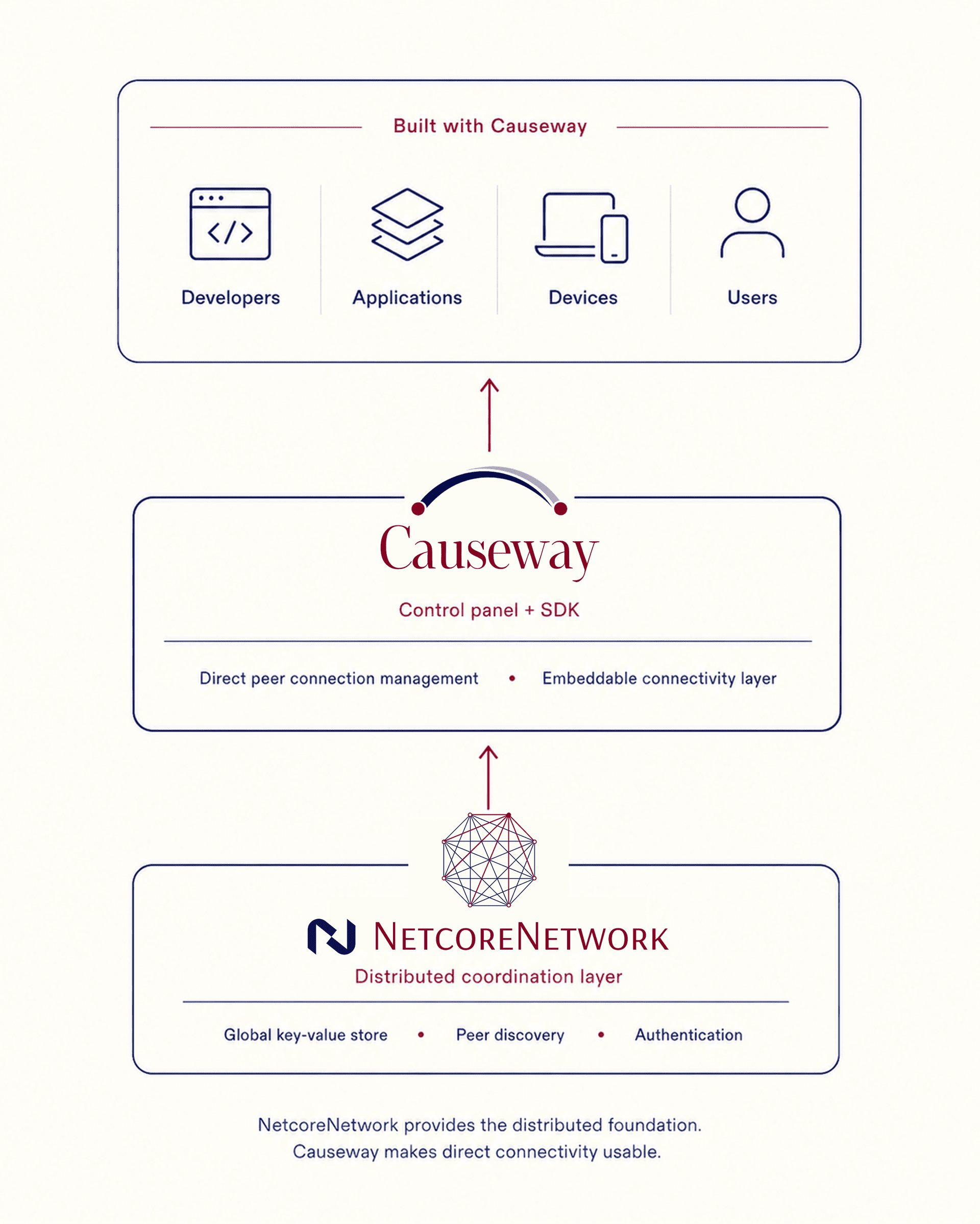
NetcoreNetwork provides the underlying infrastructure for devices to find and authenticate one another. Causeway is the layer that turns that capability into something developers and users can actually use.
Causeway is a lightweight control panel and embeddable software development kit for establishing secure, direct connections between devices. It lets you add and remove peers, manage private connections, and reach services running on another machine as though they were available locally.
That immediate utility opens up a wide range of possibilities.
You can access a self-hosted photo library while away from home, share storage across devices, reach a remote development environment, or use compute available on another machine. A service running in Docker on a friend's GPU-enabled computer can be made securely accessible to your own device without exposing it publicly or routing the entire experience through a centralized platform.
For developers, the opportunity is broader.
Causeway can be embedded directly into an application, providing the connectivity layer for private messaging, file sharing, remote device access, collaborative tools, media streaming, and other peer-to-peer experiences. Instead of building identity, authentication, peer discovery, and connection management from scratch, developers can start with a working foundation and focus on the application itself.
That changes the economics as well as the architecture. Direct connections can reduce unnecessary routing, improve latency, and remove centralized infrastructure from the critical path.
This matters because privacy-first software has traditionally asked too much of the user. The people most likely to seek out self-hosted or peer-to-peer tools are often already technically sophisticated. Everyone else may agree with the principles but still choose the product that is easiest to install and use.
Causeway is designed to help close that gap.
It gives developers a way to build applications with stronger privacy, lower latency, greater resilience, and less dependence on centralized intermediaries without requiring the end user to understand the architecture underneath.
The data stays between the people and devices it belongs to.

The coordination layer
NetcoreNetwork is the distributed foundation that allows devices using Causeway to find and authenticate one another across the internet.
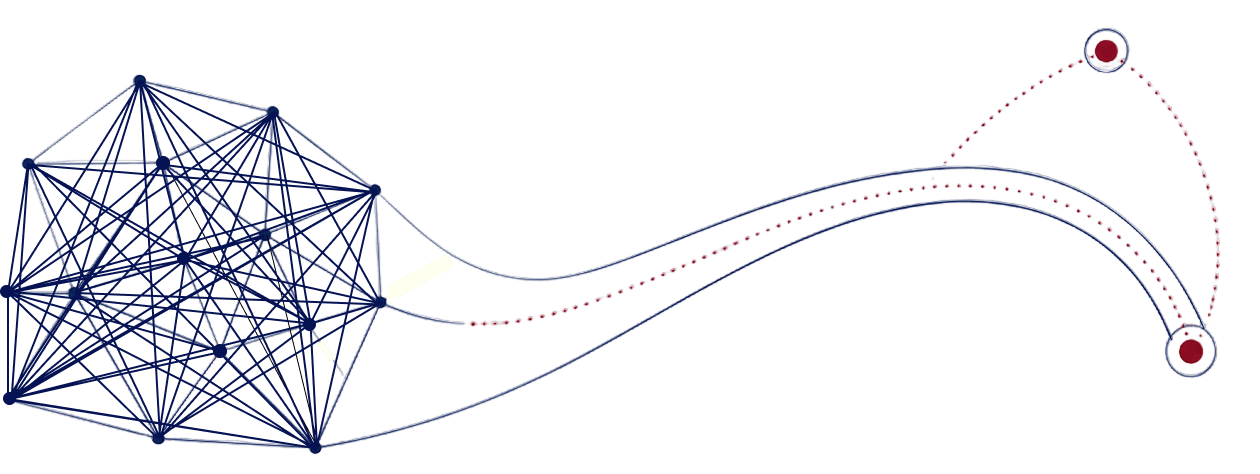
At its core, NetcoreNetwork functions as a globally synchronized key-value store. Nodes distributed around the world maintain a shared view of network state, allowing one device to reliably locate another and establish a secure connection.
Its consensus mechanism is designed around useful network participation rather than proof of work or proof of stake. The network enforces a fully connected mesh of nodes so that the most current state remains quickly accessible from anywhere in the system.
For Causeway, the primary role of NetcoreNetwork is simple: help devices discover where their peers are and verify who they are connecting to. Once that coordination is complete, application data moves directly between the devices rather than through the blockchain or a centralized relay.
NetcoreNetwork provides the global coordination layer. Causeway turns it into a usable connection layer. Developers can then build applications on top without recreating the underlying discovery, authentication, and synchronization infrastructure themselves.
Use Cases and Practical Applications
Causeway creates secure, direct connections between devices, unlocking a wide range of applications:

Build P2P Apps
Embed Causeway into messaging, file-sharing, collaboration, media-streaming, or remote-access applications. Causeway handles the underlying peer discovery, authentication, and connection management so developers can focus on the product.
.0qkeshq734__g.png&w=96&q=75)
Remote Access
Access self-hosted services anywhere with Causeway.
Reach applications running on a home server, NAS, Raspberry Pi, or other private device without exposing them publicly or routing access through a centralized platform.
.0pf.ks9ed5nvl.png&w=96&q=75)
Share Resources
Causeway enables the sharing of storage and compute across devices. Use resources available on another trusted machine as though they were part of your local environment.
Access remote files, run workloads on a more powerful device, or use a friend's GPU without moving anything into the cloud.
.03xmw2ki.400q.png&w=96&q=75)
Connect Edge Devices
Create secure connections between IoT devices, cameras, sensors, and edge systems, even when they move between networks or sit behind NATs and firewalls.
Let's build the future of the decentralized web
Netcore represents a fundamental shift in internet architecture, aligning the capabilities of modern devices with an infrastructure designed for today's needs.
Connect Devices Directly